
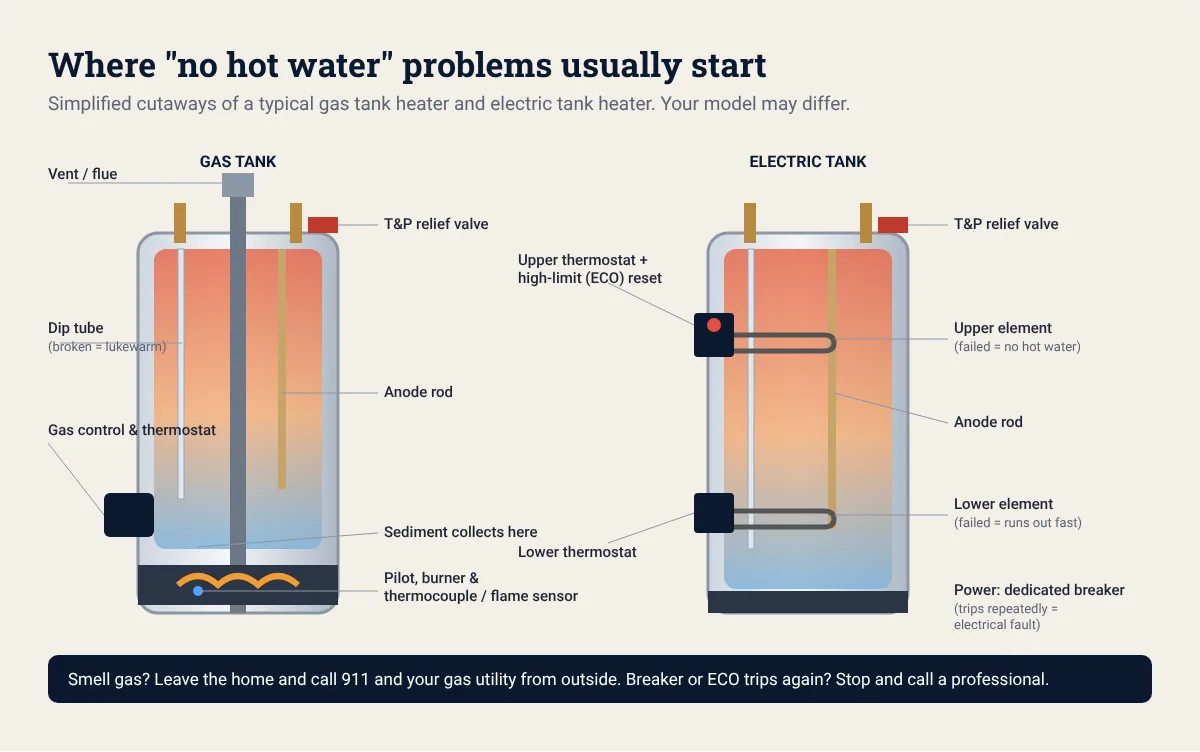
Short answer: When a water heater stops making hot water, the cause is usually simple to narrow down. On a gas heater, look first at the pilot or burner and the gas supply. On an electric heater, look first at the breaker, the high-limit reset button, or a failed heating element or thermostat. If you get some hot water but it runs out fast or is only lukewarm, the usual causes are sediment, a broken dip tube, a failed lower element, or a heater that is too small for your household.
This guide walks you through the checks a homeowner can safely make, explains what each symptom usually means, and tells you where to stop and call a professional. Gas, electricity, and scalding water are all involved, so the line between “safe to check” and “leave it to a technician” matters.
First, describe the problem precisely
“No hot water” can mean several different things, and each one points to a different part of the system. Before you touch anything, notice which of these fits your situation:
- No hot water anywhere in the house. The heater is not heating at all. This is usually a power, gas, ignition, or control problem.
- Lukewarm water, or hot water that runs out quickly. The heater works, but not at full capacity. This is usually a failed lower element, sediment, a broken dip tube, or a heater that is too small.
- Only one faucet or shower is cold. The heater is probably fine. The problem is likely at that fixture, for example a worn shower mixing cartridge.
- The water was fine yesterday and is suddenly cold after a storm or power outage. Check the breaker, the pilot, and the reset button first.
Quick checks you can safely do
These checks don’t require opening any gas or electrical components:
- Check the temperature setting. Dials sometimes get bumped, especially in garages and closets. The U.S. Consumer Product Safety Commission recommends about 120°F to reduce the risk of scald injuries. If the dial is set far below that, raise it a little and wait an hour or so.
- Electric heaters: check the breaker. Look for a tripped double-pole breaker labeled for the water heater. Reset it once. If it trips again, stop. A breaker that keeps tripping means there is an electrical fault that needs a professional.
- Gas heaters: check that gas is reaching the house. Are your gas stove or furnace working? If none of your gas appliances work, contact your gas utility.
- Gas heaters: look at the status light or sight window. Many newer gas heaters have a status light on the gas control that blinks a code. Write the code down and look it up in the owner’s manual or on the label on the heater.
- Look for water on the floor. A leak combined with a heating problem changes the diagnosis. See our guide on what a leaking water heater means.
If you smell gas, stop here. Do not try to relight anything, do not flip switches, and do not use your phone inside. Leave the home, then call 911 and your gas utility from a safe distance. In much of North Texas the gas utility is Atmos Energy, which publishes guidance on recognizing a gas leak and a 24-hour emergency number.
Gas water heater not heating: common causes
1. The pilot or burner is out
Many older gas tank heaters use a standing pilot, a small flame that lights the main burner. Drafts, a gas supply interruption, or a dirty pilot assembly can put it out. Some heaters have instructions on the label for relighting. Follow those only if the label is readable, you understand the steps, and there is no gas smell. If the pilot will not stay lit, don’t keep trying.
2. A failing thermocouple or flame sensor
The thermocouple (or a similar flame-sensing part) tells the gas control that the pilot is lit. If it fails, the control shuts the gas off as a safety measure, and you get a pilot that lights but goes out as soon as you let go of the button. This part needs a technician to diagnose and replace. It’s one of the more common gas water heater repairs.
3. Gas control valve problems
The gas control valve regulates gas to the burner and holds the thermostat. When it fails, the heater may not light or may not reach temperature. This repair needs a qualified technician.
4. Flammable vapor sensor or venting shutdown
Many modern gas water heaters are designed to shut down if they detect flammable vapors or a venting problem. If paint, gasoline, or solvents are stored near the heater, or the area is very dusty, the unit may lock out. Repeated venting shutdowns are a safety issue, because exhaust gases need to leave the house properly. Have a professional inspect it rather than resetting it over and over.
For gas-specific repairs in our area, see gas water heater repair in Dallas.
Electric water heater not heating: common causes
1. A tripped breaker
Electric tank heaters draw a lot of current, and a breaker can trip during a storm or because of a fault in the element or wiring. As mentioned above, reset it once. If it trips again, there is a fault to find.
2. The high-limit (ECO) reset has tripped
Most electric tank heaters have a high-limit switch, often with a red reset button behind the upper access panel. It cuts power if the water overheats. Pressing the reset can restore heat, but this involves removing a cover from an energized appliance. Only do it with the breaker off, and only if your owner’s manual describes it. A high-limit switch that trips more than once is a symptom. A stuck thermostat or a shorted element is usually behind it, and that needs a repair.
3. A failed heating element
Most residential electric tanks have two elements. If the upper element fails, you typically get no hot water. If the lower element fails, you usually get a small amount of hot water that runs out quickly. Elements are tested with a meter while the power is off and replaced with the tank drained or isolated. That is a job for a trained technician.
4. A failed thermostat
Each element has its own thermostat. A failed thermostat can leave an element permanently off, or permanently on, which can trip the high-limit switch. Thermostats and elements are often checked and replaced together.
Read more about electric water heater repair in Dallas.
Lukewarm water or hot water that runs out fast
Sediment buildup
Water heaters collect mineral sediment at the bottom of the tank over time. Sediment takes up space, insulates the water from the gas burner, and can cover the lower element in electric tanks. Common signs are popping or rumbling sounds and less hot water than you used to get. Regular flushing helps prevent this. See our water heater maintenance guide.
A broken dip tube
The dip tube carries incoming cold water to the bottom of the tank. If it cracks or breaks, cold water mixes with the hot water near the top. The result is lukewarm water at the faucet even though the heater is working. Small white plastic pieces in faucet aerators can be a clue.
The heater is too small for how you use it
If your household has grown, or you’ve added a large soaking tub, a 40-gallon tank may simply not keep up. Heaters also take longer to recover in winter, because the incoming water is colder. If the heater is working correctly but running out every day, the fix is a bigger tank or a different type of heater, not a repair. Our guide on whether to repair or replace a water heater covers that decision.
What about tankless water heaters?
Tankless units heat water on demand and report most problems through error codes. Common causes of cold water include scale buildup in the heat exchanger, a flow rate too low to activate the burner, ignition or flame failures, and venting problems. Write down the error code shown on the display, check your manual, and see our page on tankless water heater repair.
When to stop and call a professional
Call a qualified technician if any of the following apply:
- You smell gas, or the pilot will not stay lit.
- The breaker or the high-limit reset trips more than once.
- You see scorch marks, melted wire insulation, or water near electrical components.
- The heater is leaking from the tank itself.
- The gas heater shows a venting or flame-sensor error code.
- You’ve done the basic checks above and still have no hot water.
If you’re in the Dallas area and want someone to diagnose it, call us at (972) 961-2359. We answer 24/7. You can also request service online. For a full overview of what we work on, see our Dallas water heater repair page.
Frequently asked questions
Why is my water heater not heating even though the reset button was pressed?
Pressing the high-limit reset only restores power to the heating circuit. If a heating element, thermostat, or wire has failed, the heater still will not heat. If the reset trips again, a fault is causing the water to overheat or the circuit to short. Both need a professional diagnosis.
How long should it take a water heater to heat up?
It depends on the size and type of heater, the fuel, and how cold the incoming water is. Gas tanks usually recover faster than standard electric tanks of the same size. Your owner’s manual or rating label lists the recovery rate. If the heater never reaches temperature after several hours, something is wrong.
Can I fix a water heater with no hot water myself?
You can safely check the thermostat setting and the breaker, and you can relight a pilot if the label instructions are clear and there’s no gas smell. Replacing elements, thermostats, thermocouples, or gas controls involves electricity, gas, and hot pressurized water. That work is best left to a trained technician. In Texas, plumbing work is regulated by the Texas State Board of Plumbing Examiners.
Is a water heater with no hot water an emergency?
No hot water on its own is usually not dangerous, just inconvenient. It does become urgent if you smell gas, see water spreading near electrical equipment, or the tank is leaking. In those cases, follow the safety steps above and call for help right away. Our emergency water heater service page explains what to do.
The bottom line
Start with the simple, safe checks: the temperature setting, the breaker, the gas supply, and the status light. The specific symptom (no hot water, lukewarm water, or hot water that runs out fast) will point you toward the likely cause. When the fix involves gas parts, electrical components, or the tank itself, have a professional handle it.